
3 tips for surviving grief and loss, from the true experts
Patients with a serious chronic illness share how they face powerlessness and constant change.


Hi cacti,
It’s been a minute! I started my new job at the beginning of the month. After one week of meeting my coworkers and trying to learn as much as I could about pulmonary hypertension, I then spent a few days at PHA 2026 in Dallas. So far, so good (but also, I’m tired). My first contribution? Interviewing patients for our wrap-up story about the conference.
PH is a very complex, serious disease with many causes and subtypes. Because of the interdependency of the lungs and the heart, both organ systems can be damaged by PH, sometimes terminally.
As you can imagine, it can be terrifying to get such a diagnosis, which often comes after the disease has already progressed to the point of causing shortness of breath and fainting spells. For patients with PH, meeting others who understand this struggle is key, which is how PHA was created: By and for patients and caregivers.
At the conference, I wandered in and out of sessions, but one in particular resonated with me: Managing Anxiety and Depression with PH. Three very strong, very amazing patients shared their journeys, and they offered advice that is relevant to not just PH patients, but anyone who is going through something incredibly hard with no clear end in sight. Iin particular:
Acknowledge the layered trauma: With a disease like PH, you are trapped by lungs that don’t work normally. To “just breathe” isn’t possible. This is a traumatizing reality in and of itself, but on top of this, the broken healthcare system can make it worse, via misdiagnosis, neglect, harmful care, gaslighting, malpractice, or even toxic positivity (“just look on the bright side!”) This layered impact is common regardless of what type of trauma you have. A victim of crime not only must endure the crime, but also the justice system’s ineptitude, and so on. (For an incredible memoir about crime-related layered trauma, see the book “Know My Name: A Memoir.”)
Acknowledge the layered loss: Change of any kind comes with loss, some of which is easier to handle than others. A devastating medical diagnosis often requires grieving, mourning what has been lost and may never be regained. And it’s a constant sense of loss, especially when the disease is progressive. It wasn’t until I started acceptance and commitment therapy that I started to see how I needed to mourn the loss of my family members as I knew them before they developed severe mental illness, and how I also had to accept the chaos of a new normal. With my mother’s mental illness specifically, I first had trauma related to her suicide attempts (mainly nightmares and hypervigilance), but I also had ambiguous loss: She was still alive, but our relationship had radically changed. I also had anticipatory loss, especially after she attempted suicide again (this type of loss can feel a lot like PTSD). Thank god for therapy, which brings me to…
Talk to a therapist, along with friends and family. If only to have a neutral person in your life who can hold your trauma and loss for you when you aren’t feeling strong enough. They are literally paid to receive your sorrow. It won’t always fix everything, but each time you tell your story to someone else, you will feel a little bit less alone, layer by layer.
In other news
I’m continuing to futz around with collage, but it’s slow with the new job. (Oddly enough, one of the PH speakers at the mental health session is an artist in San Antonio and recently hosted a workshop called “Death Planning Through Collage.” I totally would have gone had I known about it!)
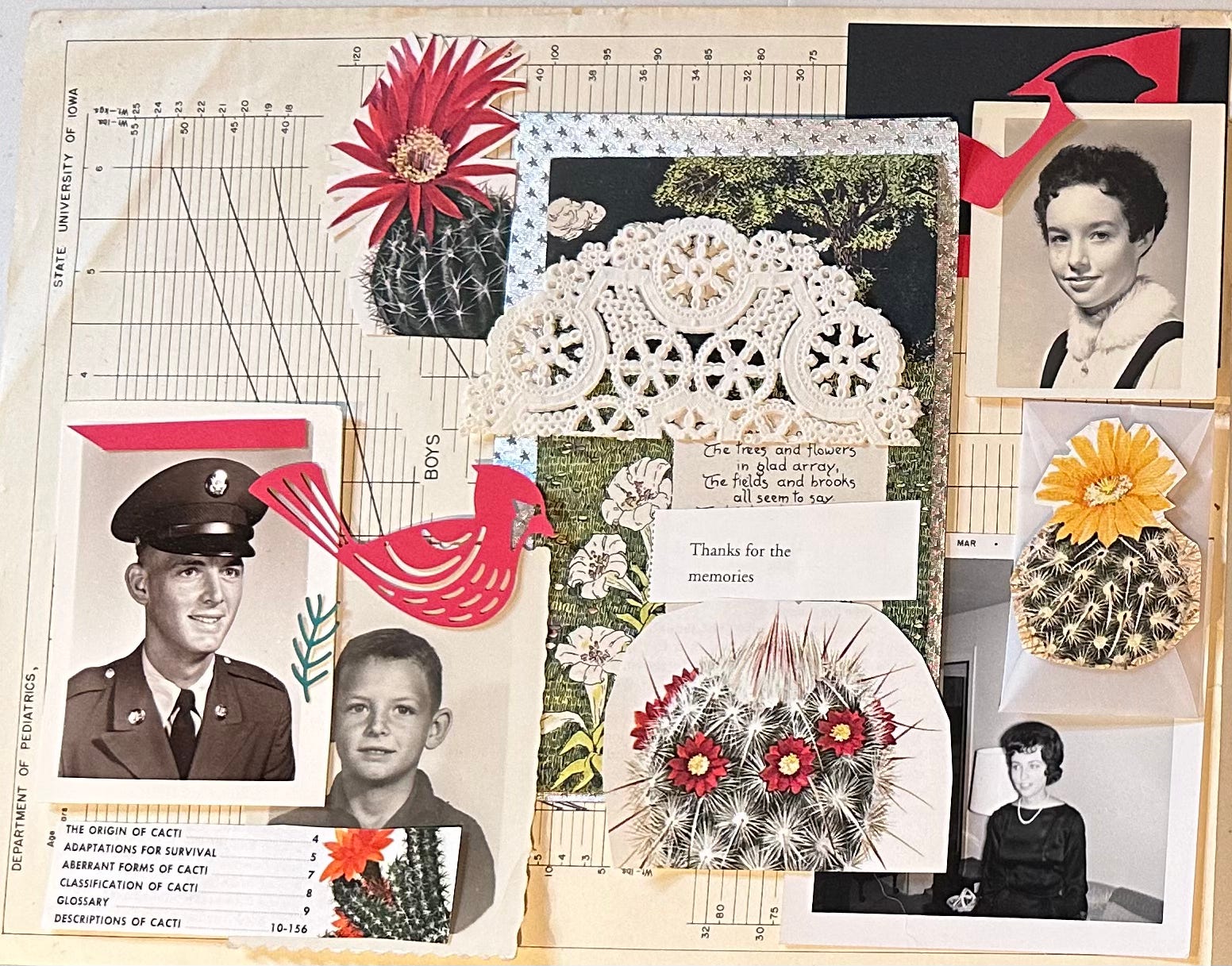
Here’s one I’ve been working on, about my parents. My mother is in a nursing home, and my father is planning to downsize. When I visited recently, I brought home some of their old photos and records. I paired it with my beloved cactus cutouts and random finds from the fabulous Austin Creative Reuse store. The symbolism here is that I have a prickly relationship with my mother, who happens to be a gifted succulent gardener. I haven’t glued any of it together yet, as I am not sure I want affix everything permanently, especially their old photos. So far, I’m enjoying arranging things, and then taking photos of the layout (although I am struggling to take photos that don’t have my phone’s shadow, so these are always a little off-kilter):
That’s all for now - thank you for reading! (I wish I had more time for my newsletter, too!)
Congrats on the new job! Sounds like there will be some writing overlap.
It sounds like the new job is going well. Learning a new discipline is exciting, in my opinion. Finding overlap between what you're learning and issues of personal concern is a bonus. Enjoy.